
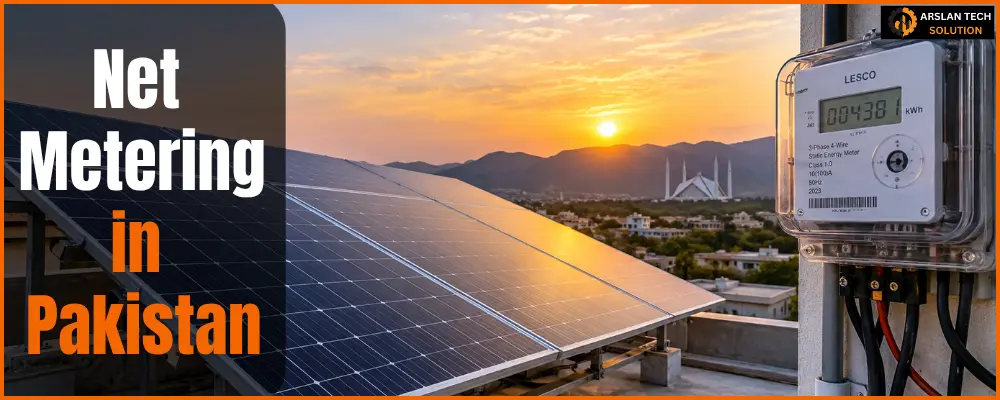
Pakistan introduced major changes to its net metering policy in 2026. On February 9, the National Electric Power Regulatory Authority (NEPRA) notified the Prosumer Regulations, 2026, introducing a net billing system for new eligible solar connections.
Under net billing, electricity imported from the grid and surplus solar electricity exported to the grid are valued separately. As a result, exporting 100 units of electricity does not necessarily offset the cost of importing 100 units.
However, net metering has not ended for every solar consumer in Pakistan. Qualifying customers with valid agreements under the previous regulations can retain their earlier billing mechanism until their agreements expire, subject to specific conditions.
The 2026 changes also affect pending applications, new connection approvals, solar export compensation, and system expansions.
This guide explains the latest net metering rules in Pakistan, who is affected, how net billing works, what happens to existing users, and how to check which regulations apply to your solar connection.
What Is the New Net Metering Policy in Pakistan in 2026?
Pakistan’s current regulatory framework is based on the National Electric Power Regulatory Authority (Prosumer) Regulations, 2026, notified through SRO 251(I)/2026 on February 9, 2026, together with subsequent amendments.
The main change is the introduction of net billing for new eligible solar connections.
Under the new arrangement:
- Electricity imported from the grid is charged at the applicable consumer tariff.
- Electricity exported to the grid is valued using the applicable export purchase price.
- Imported and exported electricity are accounted for at their respective financial values.
- Qualifying agreements under the earlier regulations may retain their previous billing arrangements until expiry.
The rules depend on your connection status. A homeowner with a signed agreement under the old framework may be treated differently from someone applying for a new solar connection.
Official source: NEPRA Prosumer Regulations, 2026 — SRO 251(I)/2026
Which Net Metering Rules Apply to You?
Before comparing tariffs or estimating solar savings, identify your customer category.
| Your situation | General position under the 2026 framework | What to check |
| Existing customer with a valid agreement under the previous regulations | May retain the earlier billing mechanism until the agreement expires, subject to the savings provisions | Signed agreement, expiry date, and approved capacity |
| Application submitted before February 9, 2026, but not completed | Treatment depends on the applicable transition process and documented milestones | Application, demand notice, payment receipt, and approval records |
| New solar applicant | Generally subject to the 2026 net billing framework | Eligibility, connection requirements, and export compensation |
| Existing customer renewing an agreement | Previous billing terms should not be assumed to continue automatically | Expiry date and renewal requirements |
| Existing customer increasing solar capacity | A material modification affecting maximum electrical output may end protection under the earlier billing mechanism | Approved output, equipment changes, and written confirmation |
The date solar panels were installed does not, by itself, establish which rules apply.
For example, purchasing solar equipment before February 9, 2026, is not equivalent to having a valid agreement executed under the earlier regulations.
Similarly, submitting an application does not necessarily provide the same regulatory position as completing the approval and agreement process.
The most important documents are your signed agreement, application records, approved generation capacity, and any subsequent modifications.
What Changed in Pakistan’s Net Metering Rules in 2026?
Several regulatory developments shaped Pakistan’s solar net metering transition.
1. The Previous Net Metering Framework of 2015
Pakistan’s earlier system operated under the NEPRA (Alternative and Renewable Energy) Distributed Generation and Net Metering Regulations, 2015, notified through SRO 892(I)/2015.
This framework allowed eligible electricity consumers to install distributed renewable generation facilities, use their generated electricity, and export qualifying surplus electricity to the distribution network.
A bidirectional meter recorded electricity imported from and exported to the grid.
The relevant regulations and agreements determined how those readings were treated for billing purposes.
The 2015 framework remains important because the 2026 transitional provisions protect qualifying agreements executed under the earlier regulations.
Official source: NEPRA Legal Register — 2015 Net Metering Regulations
2. February 9, 2026: Introduction of Net Billing
On February 9, 2026, NEPRA issued SRO 251(I)/2026, introducing the Prosumer Regulations, 2026.
The regulations replaced the earlier net metering framework, subject to applicable transitional and savings provisions.
A prosumer is an electricity consumer who also generates electricity through an eligible distributed generation facility.
Under Regulation 14 of the original February regulations:
- Electricity supplied by the distribution licensee to the prosumer is billed at the applicable tariff.
- Electricity supplied by the prosumer to the licensee is valued using the National Average Energy Purchase Price (NAEPP).
- The resulting financial values are used under the prescribed net billing mechanism.
This means that the number of exported electricity units alone cannot determine how much a consumer saves.
3. April 2, 2026: Protection for Existing Agreements
On April 2, 2026, NEPRA notified SRO 547(I)/2026, amending Regulation 21(2) of the Prosumer Regulations.
The amendment protects qualifying approvals, licences, concurrences, and agreements granted or executed under the previous regulations.
Importantly, a distributed generator with a valid agreement executed under the repealed regulations can continue to be billed according to the earlier rate and billing mechanism until the agreement’s term expires.
However, this protection is conditional.
The amendment provides that protection relating to the previous rate and billing mechanism ceases if a material modification to the distributed generation facility changes its maximum electrical output.
The amendment also states that this provision is deemed effective from February 9, 2026.
Therefore, existing customers should not assume that every change to their installation is financially neutral.
Official source: NEPRA SRO 547(I)/2026 — April 2 Amendment
4. April 2026: Concurrence and Technical Regulations
NEPRA also issued additional regulatory instruments in April 2026, including:
| Notification | Date | Subject |
| SRO 692(I)/2026 | April 27, 2026 | NEPRA Concurrence Regulations |
| SRO 693(I)/2026 | April 27, 2026 | Technical Standards for Grid Connectivity |
| SRO 709(I)/2026 | April 28, 2026 | Prosumer-related fees |
These instruments are relevant because financial eligibility and technical permission to connect a solar system are different matters.
A solar installation may need to satisfy technical, safety, and connection requirements even when its billing arrangement is understood.
The applicable requirements should be checked against the relevant notification and the distribution licensee’s current procedures.
5. August 6, 2026: Approval Requirements for Systems of 25 kW or Less
On August 6, 2026, NEPRA issued SRO 1330(I)/2026, amending the Prosumer Regulations.
A significant change was made to Regulation 4(1).
Under the amendment, a prosumer with a distributed generation facility of 25 kW or less does not need to obtain concurrence from NEPRA. Instead, the concerned distribution licensee grants the required approval.
This is a change in the approval authority, not an automatic exemption from connection requirements.
For example, a household proposing a 10 kW grid-connected solar facility must still comply with the applicable requirements and obtain the necessary approval from its distribution licensee.
The amendment also updated references to concurrence or approval in other provisions and the prescribed interconnection agreement.
Official source: NEPRA SRO 1330(I)/2026 — August 6 Amendment
Net Metering vs Net Billing in Pakistan: What Is the Difference?
The main difference between net metering and net billing is how electricity imported from and exported to the grid is financially settled.
Under the previous net metering framework, qualifying consumers received billing treatment according to the earlier regulations and their agreements.
Under the new net billing framework, imported and exported electricity are valued separately.
| Feature | Previous net metering framework | New net billing framework |
| Solar electricity used directly | Reduces electricity purchased from the grid | Reduces electricity purchased from the grid |
| Electricity imported from the grid | Billed under the applicable earlier arrangement | Billed at the applicable consumer tariff |
| Electricity exported to the grid | Treated under the qualifying previous mechanism | Valued at the applicable export purchase price |
| Billing basis | Earlier regulations and agreement | Separate import and export financial values |
| Main consideration | Whether the previous agreement remains protected | Difference between import charges and export compensation |
| Customer eligibility | Depends on valid earlier arrangements and savings provisions | Generally applies to new eligible prosumers |
Simple Example
Suppose your solar panels generate more electricity during the day than your home needs.
The surplus electricity flows into the grid.
At night, when your solar panels are not generating electricity, your home imports electricity from the grid.
Under net billing, the exported electricity earns a monetary value at the applicable purchase rate. The electricity imported at night is charged at the applicable consumer tariff.
If the import tariff is higher than the export purchase rate, importing 100 units can cost more than the credit earned from exporting 100 units.
This is one reason why using solar electricity directly in your home can be financially more valuable than exporting it.
However, the actual difference depends on your applicable tariffs, contract, and consumption pattern.
What Is the Solar Export Rate in Pakistan in 2026?
The solar export rate in Pakistan is the purchase price used to determine the financial value of electricity exported by an eligible solar prosumer.
There is an important distinction between the pricing terms used in the regulatory framework.
National Average Energy Purchase Price (NAEPP)
The original February 2026 Prosumer Regulations refer to the National Average Energy Purchase Price when describing the export purchase mechanism under net billing.
Regulation 14 also gives NEPRA the authority to revise the relevant rate through notification during the agreement, with the revised rate treated as incorporated into the agreement.
Therefore, the export rate should not be treated as permanently fixed simply because it applied when the connection was approved.
National Average Power Purchase Price (NAPPP)
The National Average Power Purchase Price is a separate regulatory pricing term associated with earlier and transitional arrangements.
NAEPP and NAPPP should not be used interchangeably.
The applicable pricing basis must be established from the relevant regulations, tariff determinations, and consumer agreement.
What Is the Current Rate Per Unit?
A single universal export rate cannot responsibly be quoted for every solar customer in October 2026 without establishing the relevant tariff determination and billing category.
The price applicable to a new prosumer may differ from the billing treatment preserved under a qualifying older agreement.
An announced rate from a previous period should also not automatically be treated as the current rate.
How to Check Your Applicable Solar Export Rate
- Identify your agreement type. Determine whether your connection operates under a protected older agreement or the 2026 net billing framework.
- Check your billing period. Use the month and year of the bill you want to verify.
- Review the applicable pricing mechanism. Identify whether the governing documents refer to the older billing arrangement or the export compensation provisions of the Prosumer Regulations.
- Locate the relevant NEPRA tariff determination or notification. Confirm the rate, effective date, and customer category.
- Compare it with your electricity bill. Check the exported units, applicable rate, and financial credit.
- Request written clarification if the figures differ. Your distribution licensee should be able to identify the applicable billing basis.
Useful official resources include the NEPRA website, NEPRA Legal Register and NEPRA Notifications.
How Does Net Billing Affect Your Electricity Bill?
Net billing changes the financial relationship between electricity consumed from the grid and surplus electricity exported from a solar installation.
Three quantities matter:
- Solar electricity consumed directly by your home or business.
- Electricity imported from the grid.
- Surplus solar electricity exported to the grid.
Electricity used directly from your solar panels does not need to be purchased from the grid at that moment.
Exported electricity, by contrast, is assigned a financial value under the applicable settlement mechanism.
Example of a Monthly Net Billing Calculation
Consider a household with the following hypothetical monthly figures.
| Description | Example value |
| Electricity imported from the grid | 300 kWh |
| Electricity exported to the grid | 200 kWh |
| Assumed import rate | Rs. 40/kWh |
| Assumed export rate | Rs. 10/kWh |
These are illustrative rates, not verified current NEPRA tariffs.
Step 1: Calculate Imported Electricity Charges
Imported electricity × assumed import tariff
300 × Rs. 40 = Rs. 12,000
Step 2: Calculate Exported Electricity Value
Exported electricity × assumed export purchase rate
200 × Rs. 10 = Rs. 2,000
Step 3: Calculate the Illustrative Energy Difference
Rs. 12,000 − Rs. 2,000 = Rs. 10,000
In this simplified example, the difference between imported electricity charges and the value of exported electricity is Rs. 10,000.
However, Rs. 10,000 is not necessarily the final electricity bill.
Actual bills may include fixed charges, taxes, surcharges, tariff adjustments, and other applicable amounts. The treatment of credits also depends on the governing regulations and agreement.
The example demonstrates the effect of separate import and export valuation. It does not establish the final payable amount for a particular consumer.
What Happens If Your Solar Export Credit Exceeds Import Charges?
Regulation 14(2) of the original February 2026 Prosumer Regulations addresses situations in which the billed value of electricity supplied by the prosumer exceeds the billed value of electricity supplied by the licensee.
Under that provision, the net billed amount is credited against the prosumer’s next billing cycle or paid by the licensee quarterly.
The applicable treatment should be read together with any relevant amendments, subsequent directions, and the consumer’s agreement.
A credit balance should therefore not automatically be interpreted as an immediate cash payment.
When reviewing your electricity bill, check the import reading, export reading, rates, applied credit, carried-forward amount, and any other charges.
Why Is Direct Solar Consumption Important Under Net Billing?
Direct solar consumption means using electricity from your panels while they are generating it, instead of sending the surplus to the grid.
For example, running a washing machine, water pump, or other suitable household appliance during solar generation hours can reduce the electricity that must be imported later.
Consider an illustrative situation where the applicable import tariff is Rs. 40/kWh and the export purchase rate is Rs. 10/kWh.
Using one additional kWh of solar electricity directly could avoid purchasing one kWh at the assumed import tariff, whereas exporting that kWh would produce a credit at the assumed export rate.
The illustrative financial difference is Rs. 30 per kWh.
That is not a universal savings figure. Actual results depend on tariffs, the timing of generation and consumption, system performance, and the way the bill is calculated.
The practical implication is that consumers considering a new solar installation should evaluate their daytime electricity consumption, not just the total number of units their panels may generate.
What Happens to Existing Net Metering Users in Pakistan?
Existing customers with qualifying agreements under the previous regulations are not automatically subject to the same billing arrangement as new applicants.
The April 2, 2026 amendment protects the earlier rates and billing mechanism for distributed generators with valid agreements executed under the repealed regulations until the end of their agreement terms.
However, this protection is subject to the amendment’s conditions.
What Existing Users Should Check
Review these details before making changes to your solar system:
- The date your agreement was executed.
- The expiry date of your agreement.
- The approved distributed generation capacity.
- Your licence, concurrence, or approval records, where applicable.
- Any subsequent changes to the solar installation.
- Whether those changes affect the facility’s maximum electrical output.
Two households with similar solar installations may have different billing arrangements because their agreements were executed under different regulatory circumstances.
Can Existing Users Add More Solar Panels?
Adding panels or modifying equipment may affect protection under an older agreement.
The April 2026 amendment specifically addresses material modifications that result in a change to the maximum electrical output of the distributed generation facility.
This does not establish that every repair or equipment replacement automatically ends the previous billing arrangement.
However, increasing approved output can have regulatory consequences.
Before expanding your solar system or changing an inverter, request written confirmation from your distribution licensee about how the proposed modification will affect your agreement.
What Happens When an Existing Agreement Expires?
The protection under Regulation 21(2) is linked to the term of the qualifying agreement.
Customers should not assume that the earlier rate or billing mechanism continues indefinitely.
Before the agreement expires, contact the distribution licensee to confirm the renewal procedure, applicable regulations, and proposed billing arrangement.
What Happens to Pending Net Metering Applications?
Some consumers submitted applications before February 9, 2026, but had not completed the approval and connection process when the Prosumer Regulations came into effect.
These cases require separate consideration.
The application submission date is relevant, but it does not necessarily establish entitlement to the previous billing arrangement.
The Power Division conducted a transition verification exercise involving pending applications and documentary milestones.
According to its September 5, 2026 progress report, 16,654 applications were part of the reported transition backlog, of which 11,695 had been resolved and 4,959 remained unresolved at that time.
These are historical figures reported for September 2026, not a verified live backlog for October.
Documents Pending Applicants Should Keep
| Document | Why it matters |
| Original application | Establishes the application record and date |
| Acknowledgement receipt | Supports proof of submission |
| Demand notice | Shows the relevant procedural milestone |
| Payment receipt | Supports verification of payment |
| Approval or concurrence records | Show which formalities were completed |
| Connection correspondence | Documents communications and instructions |
| Meter or connection records | Help establish the actual connection status |
If your application remains pending, contact your distribution licensee and request written confirmation of its current status.
Ask which transition criteria apply, which documents have been verified, and what steps remain.
Submitting an application before February 9, 2026, should not be treated as an automatic guarantee of earlier export rates.
How to Apply for Solar Net Billing in Pakistan in 2026
New applicants generally need to comply with the Prosumer Regulations, 2026, and the applicable connection and technical requirements.
The exact procedure depends on the proposed generation facility and the relevant distribution licensee.
Step 1: Check Your Solar System’s Eligibility
Confirm the proposed solar generation capacity, inverter specifications, electricity connection category, and technical compatibility.
Determine whether the system satisfies the applicable requirements before purchasing equipment solely for grid export.
Step 2: Identify Your Distribution Licensee
Contact the electricity distribution company responsible for your area.
Depending on the location, this may be LESCO, IESCO, MEPCO, FESCO, K-Electric, or another relevant distribution licensee.
Ask for the current prosumer application procedure and required forms.
Step 3: Prepare the Required Documents
The distribution licensee will identify the documents applicable to your connection category.
These may include consumer information, electricity connection records, system specifications, inverter documentation, electrical drawings, and other required application materials.
Step 4: Complete Technical Review and Approval
The distribution licensee may need to review the proposed installation and its compatibility with the distribution network.
Under the August 6, 2026 amendment, distributed generation facilities of 25 kW or less do not require concurrence from NEPRA. The concerned distribution licensee grants the applicable approval.
Systems outside this category must follow the relevant concurrence and approval provisions.
Step 5: Meet Metering and Interconnection Requirements
Complete the required metering, safety, protection, and interconnection arrangements.
Do not assume that purchasing a bidirectional meter or installing solar panels automatically authorizes grid export.
Step 6: Confirm the Billing Arrangement
Before the connection becomes operational, confirm the applicable export compensation mechanism, agreement terms, and billing procedure.
Keep copies of the executed agreement, approval documents, and related correspondence.
Fees, application timelines, and technical requirements should be confirmed directly with your distribution licensee.
How Does a Solar Net Meter Work?
A solar net meter measures electricity moving between a consumer’s property and the distribution grid.
During the day, solar panels generate electricity. A suitable inverter converts the generated direct current into alternating current for use by compatible household or business electrical equipment.
When solar generation is greater than immediate electricity demand, eligible surplus electricity can flow to the grid.
When generation is lower than demand, electricity is imported from the grid.
A bidirectional meter records these flows.
| Meter reading | Meaning |
| Import units | Electricity purchased from the grid |
| Export units | Surplus electricity supplied to the grid |
| kWh | Kilowatt-hour, the unit used to measure electrical energy |
Regulation 13 of the original 2026 Prosumer Regulations provides for metering capable of accurately recording electricity in both directions. It also allows a two-meter arrangement where the metering calculation produces the equivalent result.
The meter measures electricity flow. It does not independently determine the applicable financial rate.
The regulations, tariff determinations, and agreement govern how recorded units are valued.
Who Regulates Net Metering and Net Billing in Pakistan?
Several organizations have different responsibilities in Pakistan’s solar electricity framework.
| Organization | Main responsibility |
| NEPRA | Establishes the relevant regulatory framework and issues regulatory decisions |
| Distribution licensee | Handles applicable connection, approval, metering, and billing processes |
| Power Division | Coordinates government energy policy and relevant implementation measures |
| Solar prosumer | Generates electricity, consumes electricity, and may export eligible surplus generation |
NEPRA establishes regulatory requirements, while the concerned distribution licensee deals with many aspects of an individual customer’s connection and electricity bill.
For questions about a specific application, approved capacity, meter reading, or disputed charge, the distribution licensee is usually the appropriate starting point.
How to Check Which Net Metering Rules Apply to Your Connection
The safest way to understand your position is to follow a document-based process.
If You Already Have Net Metering
Locate your executed agreement and confirm its expiry date. Check your approved generation capacity and whether any later equipment changes affected maximum output.
Compare your bill with the billing mechanism protected by the applicable regulations.
If Your Application Is Pending
Review the original application, demand notice, payment receipt, and official correspondence.
Ask your distribution licensee to confirm which transition criteria apply and whether additional approvals are required.
If You Are Applying for the First Time
Confirm eligibility, technical requirements, distribution licensee approval, and the applicable export purchase mechanism before making financial assumptions.
If You Want to Expand Your Solar System
Compare the proposed installation with the currently approved generation facility.
Ask whether the change would constitute a material modification affecting maximum electrical output, and obtain written guidance before proceeding.
If Your Agreement Is Approaching Expiry
Check the expiration date and contact the distribution licensee about renewal procedures and applicable billing terms.
Do not assume that a previous arrangement renews automatically on unchanged financial conditions.
Official NEPRA Sources for the 2026 Net Metering Rules
The following official documents are useful for checking the regulatory framework.
| Regulation or notification | Main relevance |
| 2015 Net Metering Regulations | Previous framework and qualifying legacy arrangements |
| SRO 251(I)/2026 — February 9 | Original 2026 Prosumer Regulations |
| SRO 547(I)/2026 — April 2 | Protection for qualifying existing agreements |
| April 2026 regulatory instruments | Concurrence, technical requirements, and applicable fees |
| SRO 1330(I)/2026 — August 6 | Approval arrangements for systems of 25 kW or less |
For subsequent regulatory changes and tariff determinations, consult the NEPRA Legal Register, NEPRA Notifications and Power Division.
Always read the original regulations together with the relevant amendments rather than relying on an earlier version alone.
Frequently Asked Questions About Net Metering in Pakistan 2026
Is net metering banned in Pakistan in 2026?
No blanket ban applies to every existing solar customer. The 2026 Prosumer Regulations introduced net billing for new eligible arrangements, while the April 2026 amendment protects qualifying earlier agreements until expiry, subject to conditions.
Will existing net metering customers switch to net billing?
Not automatically in every case. Customers with qualifying agreements executed under the earlier regulations may retain their previous rates and billing mechanisms until those agreements expire, provided the applicable conditions continue to be met.
What is the difference between net metering and net billing?
The earlier net metering framework provided billing treatment under the previous regulations and agreements. Net billing values imported and exported electricity separately using the applicable financial rates.
What is the new solar export rate in Pakistan?
The applicable export rate depends on the governing regulations, relevant tariff determinations, and individual agreement. A rate from an earlier period should not automatically be treated as the current rate for every consumer.
Can I still sell extra solar electricity to the grid?
Yes. Eligible solar prosumers can export surplus electricity after completing the applicable approval, interconnection, and metering requirements.
What happens if my application was submitted before February 9, 2026?
Your application may fall under the transition verification arrangements. However, the submission date alone does not necessarily guarantee the previous billing mechanism. Documentary milestones and the applicable transition criteria matter.
Can I increase solar capacity under an existing agreement?
A material modification that changes the maximum electrical output of an approved distributed generation facility may end protection under the previous billing mechanism. Obtain written clarification before expanding the system.
Do solar systems of 25 kW or less need NEPRA concurrence?
Under the August 6, 2026 amendment, a prosumer with a distributed generation facility of 25 kW or less does not need concurrence from NEPRA. The concerned distribution licensee grants the approval, and other applicable technical and connection requirements remain relevant.
Can exported solar electricity completely eliminate my electricity bill?
Not necessarily. Export credits depend on the applicable purchase rate and billing mechanism. Fixed charges, taxes, adjustments, and other charges may still apply.
Is solar still financially useful under net billing?
It can be. Solar generation used directly by a household or business can reduce grid electricity purchases. Financial performance depends on installation cost, electricity consumption, daytime usage, tariffs, and export compensation.
Does a bidirectional meter decide the solar export price?
No. The meter records imported and exported electricity. The applicable regulations, tariff determinations, and agreement establish how those readings are financially valued.
Where can I verify the latest net metering policy?
Use NEPRA’s official legal register and notifications to locate the original 2026 Prosumer Regulations and subsequent amendments. For connection-specific questions, contact your distribution licensee.
Final Words
The 2026 net metering changes in Pakistan introduced a new financial framework for many grid-connected solar consumers.
New eligible arrangements generally follow net billing, under which imported and exported electricity are valued separately.
However, qualifying agreements under the previous regulations may continue under their earlier billing mechanisms until expiry, subject to the conditions introduced through the April 2026 amendment.
Pending applications require separate consideration, while the August 2026 amendment changed the approval process for distributed generation facilities of 25 kW or less.
Before installing solar panels, increasing system capacity, or calculating future electricity savings, confirm your agreement status, applicable export compensation, and current technical requirements.
The most important question is not simply whether net metering still exists in Pakistan. It is which billing rules apply to your particular solar connection.