
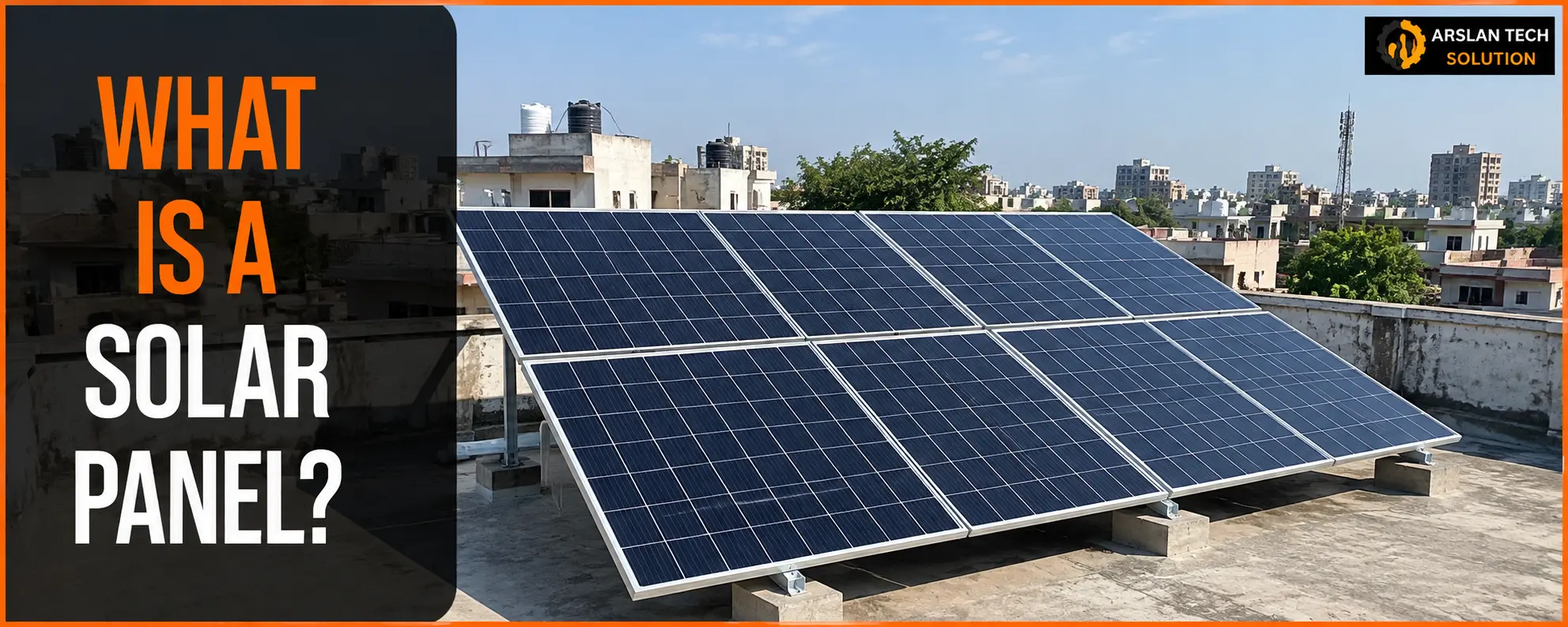
A solar panel is a device that converts sunlight into electricity using photovoltaic (PV) cells. These cells are connected within a protective structure and work together to generate electricity. Solar panels produce direct current (DC) electricity. An inverter can convert this power into alternating current (AC), which is used by most household appliances.
In Pakistan, solar panels are commonly called solar plates . Both terms generally refer to the same electricity-generating device. Solar panels are used on rooftops, commercial buildings, farms, and large solar power plants. Although they generate electricity, they are only one part of a complete solar energy system.
What is a Solar Panel?
A solar panel is an assembly of interconnected photovoltaic cells that convert light energy into electrical energy. Most commercial solar panels use silicon cells, although other photovoltaic materials are also available. When light hits the solar cells, they generate electricity through a process called the photovoltaic effect. The cells are enclosed within a protective module that helps protect them from rain, dust, humidity, and other environmental conditions.
Solar panels are also known as photovoltaic panels, PV panels, or solar modules. These terms generally describe the same type of electricity-generating device. The word photovoltaic refers to the direct conversion of light into electricity.
Solar panels should not be confused with solar thermal collectors. Photovoltaic panels generate electricity, while solar thermal collectors capture solar energy primarily for heating purposes.
What does a Solar Panel do?
The main purpose of a solar panel is to generate electricity from sunlight. For example, when sunlight hits solar panels installed on a home, the panels generate DC electricity. A solar inverter converts this electricity into AC power that can be used by home appliances such as fans, lights, and refrigerators.
If the installation includes a compatible battery system, some of the electricity generated can also be stored for later use.However, solar panels themselves do not store electricity. Their job is to generate it.
The following table explains the roles of the major components of the solar system.
| Equipment | Main function |
| Solar panel | Converts light into DC electricity. |
| Solar inverter | Converts DC electricity into AC electricity. |
| Solar battery | Stores electrical energy for later use. |
| Solar PV System | Integrates the equipment needed to generate, manage, and use solar electricity. |
These components perform different functions within a solar installation. A solar panel generates electrical power, while other devices help convert, manage, distribute, or store that power, depending on the system design.
How does a Solar Panel work?
Solar cells convert sunlight into electrical energy through a process known as the photovoltaic effect. Most commercial photovoltaic cells use silicon, a semiconductor material that allows electrical charge carriers to be generated and collected under appropriate lighting conditions.
Here’s how the process works:
1. Sunlight reaches the solar cells:
When sunlight hits the solar panel, it passes through the protective front glass and reaches the photovoltaic cells below. Sunlight carries energy in small packets called photons.
2. Solar cells absorb light energy.
The semiconductor material absorbs some of the incoming photons. Photons with sufficient energy can create mobile electrical charge carriers within a solar cell. Not all incoming sunlight is converted into electricity. Some of the light is reflected, while some of the absorbed energy is lost as heat.
3. Electrical charges are separated.
A solar cell has an internal electric field associated with its semiconductor junction. This field helps to separate the generated electrical charges, which creates a voltage in the cell. When an external circuit is connected, an electric current can flow.
4. Electrical contacts collect current.
Metal contacts collect the electrical current generated by the solar cells. The cells are interconnected so their electrical output can be combined into a useful module output.
5. Solar panels generate DC electricity.
A traditional photovoltaic solar panel provides direct current (DC) electricity. In a typical home solar installation, an inverter converts this DC power into alternating current (AC) for household use. The amount of electricity generated depends on available sunlight, panel temperature, shading, module characteristics, and other system conditions.
For example, a solar panel rated at 550 watts will not consistently produce 550 watts throughout the day. Its rated power is measured under specific test conditions, while its actual output varies during operation. It is also important to distinguish between power and energy. Watts (W) measure power, while kilowatt hours (kWh) measure energy produced or used over time.
For example, if a panel delivers an average of 400 watts for three hours, it generates approximately 1.2 kilowatts of electricity during that period.
This is an ideal calculation rather than an estimate of daily solar production.
How much electricity a panel produces depends on sunlight intensity, temperature, shading, panel characteristics, and system conditions. The rated wattage of a panel indicates its power output under specific test conditions. Actual output varies with operating conditions throughout the day.
Want to estimate how much electricity your solar installation could generate? Use our Solar Production Calculator to estimate daily, monthly, and annual energy production.
What are the Main Parts of a Solar Panel?
A typical crystalline-silicon solar panel consists of several layers and electrical components that work together to generate electricity and protect the photovoltaic cells.
| Part of a solar panel | Main function |
| Photovoltaic cells | Convert absorbed light into electrical energy. |
| Front glass | Protects cells while allowing light to pass through. |
| Encapsulant | The laminate holds and protects the cells inside the module. |
| Backsheet or rear glass | Protects the back of the module. |
| Electrical interconnections | Connect the cells and carry electric current. |
| Aluminum frame | Provides structural support and mounting edges on framed panels. |
| Junction box | Has electrical connections and often contains bypass diodes. |
| Cables and connectors | Carry DC power to other panels or system equipment. |
Photovoltaic cells
Solar cells are the electricity-generating components of a photovoltaic panel. Most commercially available modules use crystalline silicon cells. These cells are electrically connected so their individual outputs can be combined. Other photovoltaic technologies use different semiconductor materials.
Front glass and protective layers
The front glass allows sunlight to reach the cells while helping to protect them from environmental exposure. Encapsulant material supports the solar cells by enclosing them within the laminated structure. The back of the module may have a protective polymer backsheet or a second layer of glass, depending on its design.
For more information about how these layers are assembled, see the U.S. Department of Energy’s guide to solar photovoltaic manufacturing.
Aluminum frame
Many solar panels have an aluminum frame around the edges. The frame helps support the module and provides mounting edges to attach it to the installation structure. However, not all solar panels have frames. Frameless and other specialized designs use different construction methods.
Junction box and electrical connections
The junction box is usually located behind the panel. It contains electrical connections and often includes bypass diodes. These diodes provide an alternative current path around certain groups of cells under conditions such as partial shading, helping to reduce some of the associated electrical losses and hazards.
Cables and connectors carry the panel’s DC output to other modules or devices within the solar installation.
Solar Cell vs Solar Panel vs Solar Array vs Solar System
Solar cells, solar panels, solar arrays, and solar systems are interconnected, but they describe different levels of photovoltaic installation.
| Term | Meaning | Relationship |
| Solar cell or PV cell | An individual device that converts light into electricity. | Cells are connected to form modules. |
| Solar panel or PV module | An assembly of interconnected photovoltaic cells enclosed within protective materials. | Modules can be connected together. |
| Solar array | A group of electrically connected PV modules | An array forms part of a solar PV system. |
| Solar PV System | Arrangement of panels and other necessary equipment | Provides and manages electrical power for the required application. |
Their relationship can be described as follows:
Solar cell → Solar panel/module → Solar array → Solar PV system
For example, imagine a house with six solar panels connected together on its roof. Each panel contains multiple solar cells. Six connected panels form a solar array. When an inverter, wiring, mounting structures, electrical protection, and other required equipment are added, the installation becomes a complete solar PV system.
To estimate the solar system capacity and number of panels needed for your home, try our Solar Size Calculator using your monthly electricity consumption and available sunlight.
➥ Is a solar module the same as a solar panel?
Yes, in everyday usage, solar panel, solar module, and PV module usually refer to the same assembled photovoltaic device. PV module, while homeowners and solar dealers are more likely to use solar panels. These terms do not generally refer to individual solar cells or entire solar power systems.
What are the different types of solar panels?
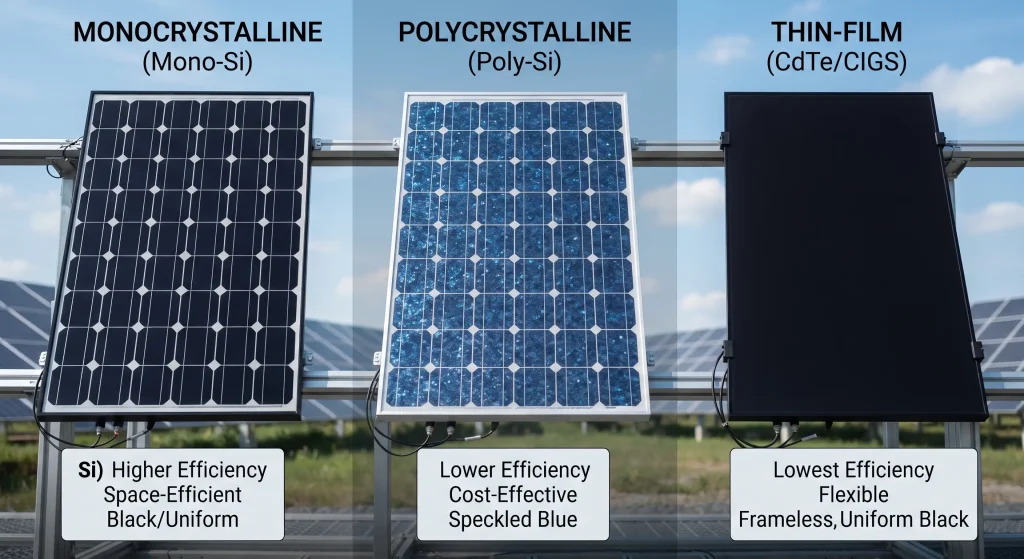
Solar panels are manufactured using various photovoltaic technologies. Key differences include the semiconductor materials, cell structures, and manufacturing methods used to convert light into electricity. The three widely recognized categories are monocrystalline, polycrystalline, and thin-film solar panels.
1. Monocrystalline solar panels
Monocrystalline solar panels have cells made of single-crystal silicon. They are widely used in residential, commercial, and industrial solar installations. Modern monocrystalline modules can provide high efficiency, making them suitable where available installation area is limited.
Their actual performance depends on the particular cell technology, module design, and operating conditions.
2. Polycrystalline solar panels
Polycrystalline solar panels use cells made of multicrystalline silicon. These are an established photovoltaic technology that has been used in residential and commercial installations. Polycrystalline panels generally have lower efficiency than many modern monocrystalline modules, although efficiency varies between products.
3. Thin film solar panels
Thin-film solar panels use thin layers of photovoltaic semiconductor materials deposited on suitable substrates. Depending on the technology, these substrates may include glass, metal, or flexible materials. Thin film technology is used in certain commercial, industrial, and specialty applications.
Its characteristics depend on the semiconductor material and the construction of the module.
What about Bifacial, N-Type, TOPCon, and HJT solar panels?
These names also commonly come up when discussing modern solar panels. However, they do not all describe separate categories in the same way as monocrystalline, polycrystalline, and thin film technologies.
- Bifacial panels are designed to collect light from both their front and back sides.
- N-type cells use n-type silicon as their primary semiconductor material.
- TOPCon cells use tunnel oxide-driven contact technology to improve electrical performance.
- HJT cells combine crystalline silicon with thin semiconductor layers to form heterojunction structures.
A solar panel may have more than one of these features. For example, a module may use n-type TOPcon cells and may also have a bifacial design. These distinctions are useful when comparing panel features, performance, construction, and efficiency.
Do solar panels need direct sunlight to work?
Solar panels need plenty of light to generate electricity, but they don't always need strong, direct sunlight. They can also generate electricity from diffused daylight, including the light available when the sky is cloudy. However, their electrical output is typically reduced when less usable light reaches the cells.
Several factors affect the performance of solar panels:
- Sunlight intensity: More usable sunlight generally allows the panel to produce more electrical power.
- Shading: Shadows from trees, buildings, or nearby objects can reduce output.
- Temperature: High cell temperature typically reduces the power output of traditional crystalline-silicon panels under otherwise comparable conditions.
- Panel orientation: The direction and angle of installation affects how much sunlight reaches the panel.
- Dust and dirt: Material that accumulates on the surface of the panel can block light and reduce power output.
These factors help explain why the actual output of a solar panel varies throughout the day and under different weather conditions.
Do solar panels work at night?
Traditional solar panels do not produce useful electrical power in the dark because there is not enough light for normal electricity production. At night, a house with solar panels must obtain power from another source, such as the electrical grid or a battery.
A synchronous battery system can provide stored electricity earlier after sunset. This is why solar panels and solar batteries have different roles in a solar energy installation.
Where are solar panels used?
Solar panels are used in applications ranging from small electrical appliances to large power generation facilities. The basic operating principle remains the same: photovoltaic cells convert light energy into electricity.
What changes the size and design of the wider solar system?
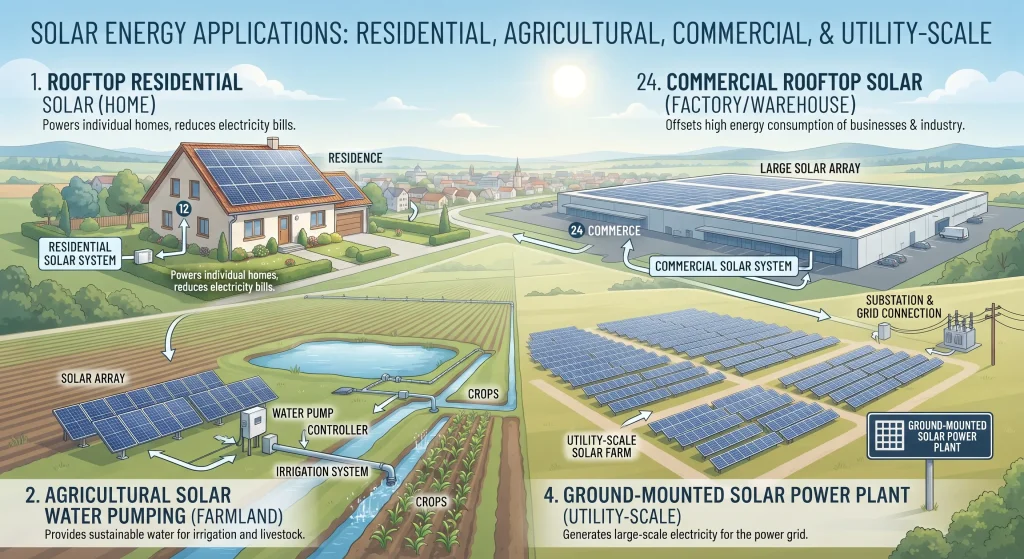
Houses and residential buildings
Homeowners install solar panels on roofs to generate electricity during daylight hours. Depending on the system configuration, the electricity can power household appliances, reduce electricity purchased from the grid, or charge batteries for later use.
Shops, offices and factories
Commercial and industrial buildings use solar systems to provide part of their electricity needs. Shops and offices can use solar energy for lighting, fans, computers, and air conditioning. Factories may need large installations to support industrial electrical loads. The need for panels and other equipment depends on the property's electrical needs.
Farms and agricultural applications
Solar panels are used in agriculture, such as for pumping water and powering certain electrical appliances. Solar-powered water pumps can be useful in places where grid electricity is unreliable, unavailable, or expensive to expand.
Schools, hospitals, and remote locations
Schools, healthcare facilities, and other institutions can use solar systems to meet their electricity needs. In remote areas, off-grid solar installations can provide electricity where traditional grid connections are unavailable or impractical. These systems may include batteries or other power sources for when power is needed during daylight hours.
Solar power plants
Large solar power plants use many interconnected photovoltaic modules to generate electricity on a very large scale. These installations require supporting equipment such as inverters, mounting structures, electrical protection, and power distribution infrastructure. Although solar installations vary in size and purpose, the panels themselves perform the same basic function.
If you're planning a rooftop installation, our Solar Panel Placement Calculator can help estimate how many panels may fit on your available roof area.
What does solar plate mean in Pakistan?
In Pakistan, solar plate is a common market term for photovoltaic solar panels. People often use the expression when discussing solar panel prices, panel wattage, solar installations, or the number of panels needed for a home. The word plate does not identify a distinct photovoltaic technology.
For example, a 550 watt mono solar panel usually means a monocrystalline solar panel with a rated power output of 550 watts. Manufacturers typically use technical terms such as solar panel or PV module, while local sellers and consumers may prefer solar plate.
What does solar panel mean in Urdu?
Solar panel is usually written as solar panel in Urdu. Another expression is solar panel (solar panel), where solar refers to the sun or solar energy.
In simple Urdu:
سولر پینل ایک ایسا آلہ ہے جو سورج کی روشنی کو بجلی میں تبدیل کرتا ہے۔
In English it means:
A solar panel is a device that converts sunlight into electricity.
Both expressions refer to the same basic photovoltaic device.
Who invented Solar Panels?
Solar panels were not invented by just one person. Their development took place over many years through the work of different scientists and engineers. In 1839, French physicist Alexandre Edmond Becquerel discovered the photovoltaic effect, which became the foundation of solar electricity technology.
During the 1880s, Charles Fritts developed an early solar cell using selenium. A major breakthrough came in 1954, when researchers Daryl Chapin, Calvin Fuller, and Gerald Pearson at Bell Laboratories developed a practical silicon solar cell. Their work helped lay the foundation for the modern solar panels used today.
Over time, improvements in solar cell technology and manufacturing made solar panels more efficient and practical for homes, businesses, and power plants.
Final Thoughts
A solar panel converts light into direct current (DC) electricity using interconnected photovoltaic cells enclosed within protective materials. Individual solar cells are connected to form a solar panel, also called a PV module.
Multiple connected modules form a solar array, while a complete solar PV system includes other equipment, such as inverters, wiring, and electrical protection devices. The solar panel generates electricity, but the complete system manages and delivers that electricity for its intended use.
Frequently Asked Questions
Not sure what system size fits your home? Run the numbers with our free calculators.
Solar Calculators
Arslan ArshadFounder, Arslan Tech Solution
About the Author – Arslan
I'm Arslan Arshad, Founder of Arslan Tech Solution, a Solar Energy Specialist and Electrical & Electronics Professional based in Lahore, Pakistan. With over 18 years of hands-on technical experience, I specialize in solar PV systems, hybrid and on-grid inverters, lithium batteries, solar system design, and troubleshooting. Through my website, I share practical solar energy guides, technical knowledge, and renewable energy solutions to help homeowners, solar technicians, and enthusiasts make informed decisions.