
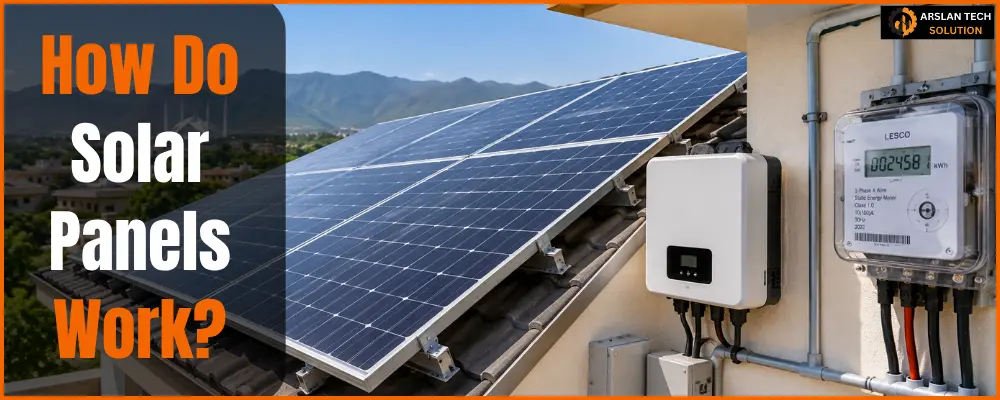
Solar panels work by converting sunlight into electricity through a process called the photovoltaic (PV) effect. Each panel contains solar cells, usually made from silicon, that absorb light energy and generate electrical charges. These charges are separated and collected to produce direct current (DC) electricity.
In a typical home solar system, an inverter converts this DC electricity into alternating current (AC), which most household appliances use.
The basic process is:
Solar panels generate electricity from light, not heat. They also do not store electricity themselves. A battery can be added to store excess energy for later use, but it is not required for solar panels to generate power.
To understand how this happens, let’s look at the components inside a solar panel, the five stages of electricity generation, and how solar electricity reaches your home.
What Is a Solar Panel?
A solar panel is a device that converts sunlight directly into electrical energy using photovoltaic cells.
Most conventional solar panels contain several silicon solar cells connected together and protected by glass, encapsulating materials, and a supporting frame. The cells generate electricity, while the surrounding layers protect them from weather and physical damage.
A single solar cell produces a relatively small amount of electricity. Connecting multiple cells creates a solar module capable of delivering more useful electrical power. Although the terms are sometimes used interchangeably, a solar cell, solar panel, solar array, and complete solar power system are not the same thing.
| Component | What It Does |
| Solar cell | Converts absorbed sunlight into electrical energy |
| Solar panel (PV module) | Connects and protects multiple solar cells |
| Solar array | Combines multiple solar panels to increase electricity production |
| Solar inverter | Converts DC electricity into AC electricity |
| Solar battery | Stores electrical energy for later use, if installed |
| Solar PV system | Combines panels and supporting equipment to supply usable electricity |
In Pakistan, solar panels are also commonly called solar plates. However, solar panel and photovoltaic module are more accurate technical terms. The important distinction is that solar panels generate electricity, while other system components convert, distribute, control, or store it.
How Do Solar Panels Convert Sunlight Into Electricity?
Solar panels convert sunlight into electricity through the photovoltaic effect. This process takes place inside their solar cells, where light energy creates electrical charges that can be separated and collected.
The process can be understood in five steps.
Step 1: Sunlight Hits the Solar Cells
Sunlight carries energy in tiny packets called photons. When sunlight reaches a solar panel, some photons are reflected from the surface, while others are absorbed by the semiconductor material inside the solar cells. The absorbed photons transfer energy to the material, making electricity generation possible.
However, not every photon contributes to electrical output. A photon must contain enough energy to create mobile electrical charges within the semiconductor. This explains an important point: solar panels do not need heat to produce electricity. They need light that their solar cells can absorb and convert into electrical energy.
Step 2: Silicon Absorbs Light Energy
Most traditional solar cells are manufactured using silicon, a material known as a semiconductor. A semiconductor has electrical properties that can be controlled through its composition and manufacturing process. Unlike a metal conductor, which allows electrical charges to move relatively freely, silicon can be engineered to support the controlled movement and separation of charges when exposed to sunlight.
When silicon absorbs a photon with sufficient energy, that energy can excite an electron into a state where it can move through the material and contribute to electrical conduction. This is one of the essential steps in converting light energy into electricity.
Step 3: Electrical Charges Are Created
When a suitable photon transfers energy to an electron inside the silicon, the electron becomes mobile. The electron leaves behind a space called a hole. An electron carries a negative electrical charge, while a hole behaves like a positive charge carrier within the semiconductor.
Together, they form what is known as an electron-hole pair. These charge carriers make electrical generation possible, but their creation alone is not enough to produce useful electricity. If an electron and hole recombine before their charges are collected, their energy cannot contribute to the panel’s useful electrical output. Solar cells are therefore designed to separate and collect these charges efficiently.
Step 4: An Internal Electric Field Separates the Charges
A solar cell contains specially engineered semiconductor regions that help separate the electrical charges produced by absorbed sunlight. In a conventional silicon solar cell, these regions commonly form a structure called a p–n junction.
The junction creates an internal electric field that helps direct electrons and holes toward different regions of the cell. This separation reduces the likelihood of immediate recombination and contributes to the voltage between the cell’s electrical contacts.
When the illuminated solar cell is connected to a suitable external circuit, electrical current can flow and deliver power. In simple terms, sunlight creates mobile electrical charges, and the cell’s internal structure helps turn those charges into useful electrical energy.
Step 5: Electrical Contacts Collect the Current
Solar cells contain conductive electrical contacts that collect the current generated inside the semiconductor. On many conventional solar cells, thin metal lines are visible on the front surface. Other solar-cell designs use different arrangements, including contacts positioned on the back.
The cells inside a solar panel are electrically connected to provide the required voltage and current characteristics. Their combined electrical output is direct current (DC) electricity. This DC electricity can supply compatible equipment or travel through electrical wiring to an inverter, where it can be converted into AC electricity for household use.
Solar Panel Working Diagram: From Sunlight to Electricity
The working principle of a solar panel involves two connected processes: generating electricity inside the solar cells and converting that electricity into a form suitable for household appliances.
Inside a Solar Cell
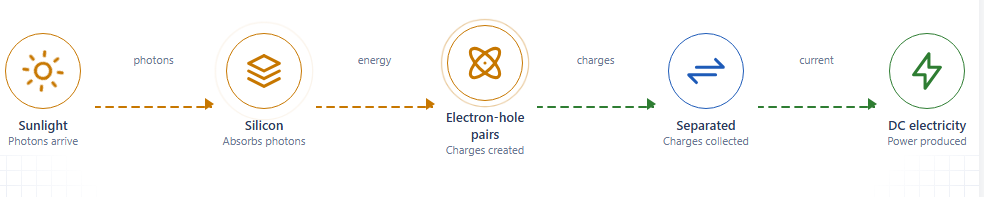
First, the solar cell absorbs suitable photons. This energy creates mobile electrons and holes inside the semiconductor. The cell’s internal electric field helps separate these charges, while electrical contacts collect the resulting current.
Inside a Home Solar System
The panels generate DC electricity. The inverter converts it into AC electricity suitable for the connected household electrical system. A battery may be added to store electrical energy, but it is not part of the basic photovoltaic conversion process.
Similarly, solar panels do not need a connection to the electricity grid to generate power. However, grid-connected systems require suitable equipment and electrical protection to operate safely.
Why Do Solar Panels Produce DC Electricity?
Solar panels produce direct current (DC) because their photovoltaic cells establish electrical polarity between their positive and negative terminals. When sunlight creates electrical charges and the cell is connected to a suitable circuit, conventional current flows through that circuit in one direction.
Alternating current (AC), by comparison, periodically reverses direction.
| Feature | DC Electricity | AC Electricity |
| Current direction | Flows in one direction | Reverses direction periodically |
| Solar application | Generated by photovoltaic panels | Supplied by an inverter for common household circuits |
| Common uses | Solar panels, batteries, suitable DC equipment | Fans, refrigerators, lights, and most household electrical systems |
| Conversion | Can be converted into AC | Can be converted into DC when required |
Most homes in Pakistan use AC electricity for their household circuits. This is why a typical rooftop solar installation includes a solar inverter. The inverter converts the DC electricity generated by solar panels into AC electricity with suitable electrical characteristics for the connected system.
Does Every Solar Panel Need an Inverter?
No. A solar panel can produce DC electricity without an inverter. An inverter becomes necessary when the electrical output needs to be converted into AC for appliances or an electrical network. Some equipment can operate directly on DC electricity, provided its voltage, current, regulation, and protection requirements are properly matched.
However, most residential solar installations use an inverter because ordinary household electrical circuits generally operate on AC electricity. For a detailed explanation of this component, see What Is a Solar Inverter and How Does It Work?
How Do Solar Panels Power a House?
Solar panels help power a house by generating electricity during daylight hours and supplying it through the home’s solar electrical system. In a typical installation, rooftop panels produce DC electricity. Wiring carries this electricity to an inverter, which converts it into AC power suitable for the household electrical circuits.
The basic electricity path is:
Sunlight → Rooftop solar panels → DC electricity → Inverter → AC electricity → Home appliances
For example, consider a home in Pakistan using fans, lights, a refrigerator, and an air conditioner during the day. As sunlight reaches the rooftop panels, they generate DC electricity. The inverter converts that electricity into AC, allowing solar power to contribute to the home’s electricity demand.
The amount supplied by solar depends on how much the panels are generating and how much electricity the home is using.
What Happens When Solar Panels Produce Less Electricity Than the Home Needs?
When solar generation is lower than household demand, another available electricity source can supply the difference. In a grid-connected system, this may be the utility grid. In a suitably configured hybrid or off-grid system, a battery or another power source may provide additional electricity. The exact arrangement depends on the system design.
What Happens When Solar Panels Generate Extra Electricity?
When solar generation exceeds the home’s current demand, the excess electricity may be:
- Exported to the electricity grid, where the system and applicable arrangements permit it.
- Stored in a battery if suitable storage equipment is installed.
- Limited by the inverter or system controls when it cannot be used, exported, or stored.
Not every solar installation supports all three options. The way electricity is managed depends on the inverter, battery arrangement, electrical connections, protection systems, and applicable utility requirements.
Can Solar Panels Power a House Without Batteries?
Yes. Solar panels can help power a home without batteries. A grid-connected solar system can use electricity generated during daylight hours without requiring battery storage. However, when sunlight is unavailable, electricity must come from another source if appliances need to keep operating.
A battery is useful when stored electricity is required after sunset or during certain power interruptions, but the system must be designed to support those functions.
What Factors Affect Solar Panel Electricity Production?
The photovoltaic effect works according to the same basic principles wherever solar panels are installed. However, the amount of electricity a panel generates varies with sunlight, temperature, shading, installation conditions, and system losses.
Understanding these factors helps explain why a panel’s actual output may differ from its rated wattage.
1. Sunlight Intensity
Sunlight provides the energy needed for photovoltaic electricity generation. The amount of solar power reaching a surface is called solar irradiance, usually measured in watts per square meter (W/m²). When more usable sunlight reaches a panel, it can generally produce more electrical current, assuming other operating conditions remain similar.
For example, a solar panel will usually generate more power under strong midday sunlight than under weak early-morning sunlight. However, the wattage printed on a solar panel does not represent the amount of electricity it will produce throughout the day.
Its rated output is determined under specified test conditions, while real-world sunlight changes continuously.
2. Solar Panel Temperature
Solar panels need light rather than high temperatures. In fact, excessive heat can reduce the electrical performance of conventional crystalline-silicon solar panels. As the solar cells become hotter, their maximum power output generally decreases when other conditions remain equal.
This is particularly relevant in Pakistan, where strong sunshine and high daytime temperatures often occur together. A hot, sunny afternoon may provide substantial solar radiation, but elevated panel temperatures can reduce conversion efficiency.
Therefore, strong sunlight and high electricity output are related, but they are not exactly the same thing.
3. Shading and Cloud Cover
Solar panels can generate electricity on cloudy days because some daylight still reaches their cells. However, electricity production normally decreases when less usable light is available. Shadows from nearby trees, buildings, utility poles, and rooftop structures can also reduce output.
Even partial shading may affect a larger section of a panel or a connected group of panels because solar cells and modules are electrically interconnected. The actual power loss depends on the shading pattern, the panel’s internal electrical design, and the wider system configuration.
Avoiding unnecessary shading is therefore important when planning a solar installation.
4. Dust and Dirt
Dust, bird droppings, and other deposits can prevent some sunlight from reaching the photovoltaic cells. When less light is absorbed, electrical production may fall. The amount of power lost depends on how much dirt is present, how it is distributed, and local environmental conditions.
Dust is an important consideration in many parts of Pakistan, particularly in dry or polluted environments. Keeping solar panels reasonably clean can help maintain their performance. However, cleaning should always follow the manufacturer’s instructions and appropriate electrical and working-at-height safety precautions.
5. Solar Panel Direction and Tilt
The direction a solar panel faces and the angle at which it is installed affect how much sunlight reaches its surface. Two identical panels can generate different amounts of electricity if they face different directions or experience different shading conditions.
The most suitable direction and tilt depend on several factors, including:
- Geographic location
- Roof orientation
- Seasonal sun position
- Nearby shading
- Desired electricity generation throughout the day
Correct positioning can help panels capture more useful sunlight over the year. For more detailed installation information, see Solar Panel Angle and Orientation.
6. Solar Panel Wattage and System Losses
Every solar panel has a rated power output, usually expressed in watts (W).
For example, a 400-watt solar panel is rated to produce 400 watts under specified test conditions. This does not mean it will continuously produce 400 watts from morning until evening. Its actual output changes with sunlight, temperature, shading, dirt, and other operating conditions.
There is also an important difference between electrical power and electrical energy.
| Unit | Meaning |
| Watt (W) | Measures electrical power at a particular moment |
| Kilowatt (kW) | Measures power; 1 kW equals 1,000 W |
| Watt-hour (Wh) | Measures electrical energy produced or consumed over time |
| Kilowatt-hour (kWh) | Measures energy; 1 kWh equals 1,000 Wh |
For example, if a solar panel delivers 400 watts continuously for one hour, it produces:
400 W × 1 hour = 400 Wh = 0.4 kWh
This is a calculation example, not an estimate of typical daily production.
In real conditions, sunlight and panel output change throughout the day. A complete solar installation also experiences electrical and conversion losses. To understand daily electricity generation in more detail, see How Much Electricity Does a Solar Panel Produce?
Why Can’t Solar Panels Convert All Sunlight Into Electricity?
Solar panels cannot convert all incoming sunlight into electrical energy because of the physical properties of sunlight and semiconductor materials. Sunlight contains photons with different amounts of energy.
In a conventional silicon solar cell, photons with insufficient energy cannot generate the electron-hole pairs needed for electricity production. When photons contain more energy than the semiconductor can use for charge generation, some of the excess energy is lost, often as heat.
Additional losses occur through several processes:
- Reflection of sunlight from the panel surface.
- Recombination of electrons and holes before their charges are collected.
- Electrical resistance within the cells and their connections.
- Heat generation and other conversion losses.
These factors limit the panel’s conversion efficiency. Solar panel efficiency describes the proportion of incoming solar energy that becomes electrical power under specified conditions.
For example, a solar panel operating at 20% efficiency converts approximately 20% of the solar energy falling on its measured area into electrical output under those conditions. This does not mean it produces only 20% of its rated wattage.
Efficiency describes how effectively sunlight is converted into electricity. Rated power describes output under specified test conditions, while actual daily energy generation depends on sunlight and real operating conditions.
Final Thoughts
Solar panels work by converting sunlight directly into electricity through the photovoltaic effect. When sunlight reaches the photovoltaic cells, suitable photons transfer energy to the semiconductor material, creating mobile electrical charges.
The internal structure of the cells helps separate these charges, while electrical contacts collect the resulting direct current. In a typical residential solar installation, an inverter converts DC electricity into AC electricity that can power household appliances.
Solar electricity production varies with sunlight, temperature, shading, panel orientation, and system conditions. Batteries can store energy for later use, but they are not required for the photovoltaic process itself.
The main idea is simple: solar panels generate electricity, inverters convert it, and batteries store it when needed.
Frequently Asked Questions
Yes. Solar panels can generate electricity on cloudy days because some daylight still reaches their photovoltaic cells.
However, output is generally lower than under strong direct sunlight.
The reduction depends on cloud conditions, available solar radiation, and the operating characteristics of the panels.
Traditional rooftop solar panels do not produce meaningful sunlight-powered electricity at night because sunlight is unavailable.
However, a house can still receive electricity after sunset from the utility grid, a battery, or another suitable power source.
A battery supplies previously stored energy. It does not make the solar panel generate electricity in darkness.
Yes. Solar panels can generate electricity during winter as long as sufficient light reaches their cells.
Cooler temperatures can actually improve the electrical performance of conventional silicon solar panels when other conditions remain equal.
However, shorter daylight hours, fog, cloud cover, shading, and changes in the sun's position may reduce total daily energy production.
Winter electricity generation therefore depends on both temperature and available sunlight.
No. Solar panels generate electrical energy but do not store it for later use.
A solar battery performs the storage function and can supply electricity when needed, depending on the system design.
Not every solar power system needs a battery.
Yes, provided the device is designed to work with the electrical output supplied by the panel.
The voltage, current, regulation, and protection requirements must be suitable.
Many household appliances operate on AC electricity, so they normally receive solar power through an inverter.
Electrical equipment should not be connected directly to a solar panel without confirming compatibility and appropriate protection.
Solar panels can continue receiving sunlight during a power outage, but that does not necessarily mean they can continue powering the house.
Traditional grid-connected inverters generally stop supplying power when the grid fails. This is an important safety feature that helps prevent unintentional energizing of electrical lines.
To supply electricity during a power outage, a solar installation needs suitable backup-capable equipment and the correct system configuration.
A battery alone does not guarantee backup operation unless the system is designed to provide it.
The amount of electricity a solar panel produces depends on its rated wattage, available sunlight, temperature, shading, direction, tilt, dirt, and other system losses.
Panel wattage is a measure of rated power, while electricity generated over time is measured in kilowatt-hours (kWh).
Two panels with the same rated wattage can produce different daily amounts of electricity when installed or operated under different conditions.
Not sure what system size fits your home? Run the numbers with our free calculators.
Solar Calculators
Arslan ArshadFounder, Arslan Tech Solution
About the Author – Arslan
I’m Arslan Arshad, Founder of Arslan Tech Solution, a Solar Energy Specialist and Electrical & Electronics Professional based in Lahore, Pakistan. With over 18 years of hands-on technical experience, I specialize in solar PV systems, hybrid and on-grid inverters, lithium batteries, solar system design, and troubleshooting. Through my website, I share practical solar energy guides, technical knowledge, and renewable energy solutions to help homeowners, solar technicians, and enthusiasts make informed decisions.